As the 2026 Scottish Parliament election approaches, keep up to date with all the latest polling and analysis on Ballot Box Scotland’s Holyrood Hub page!
Poll Details and Context
It never rains but it pours in Scottish polling. After a period of nothing but (often quite silly, and in one case just flat-out incompetent) MRPs, we were due some normal polling. Well not only did we get my very own Survation-run poll last week, but there was a second running almost concurrently. Diffley Partnership (link to original writeup) are also regular Survation clients, and have a poll that started three and concluded two after mine (link to tables).
This is simultaneously a pain and quite useful. A pain, in the sense we haven’t had much polling, so it’d have been good if the first poll out the gate after mine wasn’t another Survation or at least had different fieldwork dates. Useful, in the sense that the overlapping fieldwork is really good for illustrating the effects of margin of error.
My nigh-concurrent Survation covered the 14th – 21st of April 2026. Changes are shown as (vs that poll / vs last election).
Note: You may also notice some changes in the BBS website layout with a new theme. Hopefully all recent and relevant pieces have migrated over to the new theme alright, but if you spot anything odd, please drop me either an email or a message on Bluesky to let me know, including whether you encountered the issue on the desktop or mobile version of the website.
Regional Vote
Change vs Last Poll
Change vs 2021
Margin of error warning!
As you should expect in a poll conducted by the same firm over roughly the same period, statistically the differences here versus the other poll are meaningless. With that caveat in mind, this is nonetheless the best Survation for the Greens since early 2023, when they changed their methodology and flipped from being typically high for the Greens to on the lower end. It’s also good for the Lib Dems to see any gain at all, given that the 8% last time was their lowest in the average.
Constituency Vote
Change vs Last Poll
Change vs 2021
Margin of error warning!
Everything here is within margin of error as well, but is more worth remarking on. I had been very surprised that stripping 7% off the Green share (due to limited constituency candidacies) in the last poll had no net benefit to the SNP. Here, they are up compared to their standard 35%. Again, I emphasise this is all margin of error movement, but it could indicate that the figure in the BBS poll was an exaggeratedly low outlier. Less than two weeks to go until we can test that proposition!
The other movement in this poll takes both Labour and the Conservatives down from what had been their best shares in the average beforehand. That has mild consequences in the overall model and more substantial effects in the projection from this poll, but don’t read too much into them in isolation.
Seat Projection
Projecting that into seats might give us something like this:
Please see this page for how projections work and important caveats.
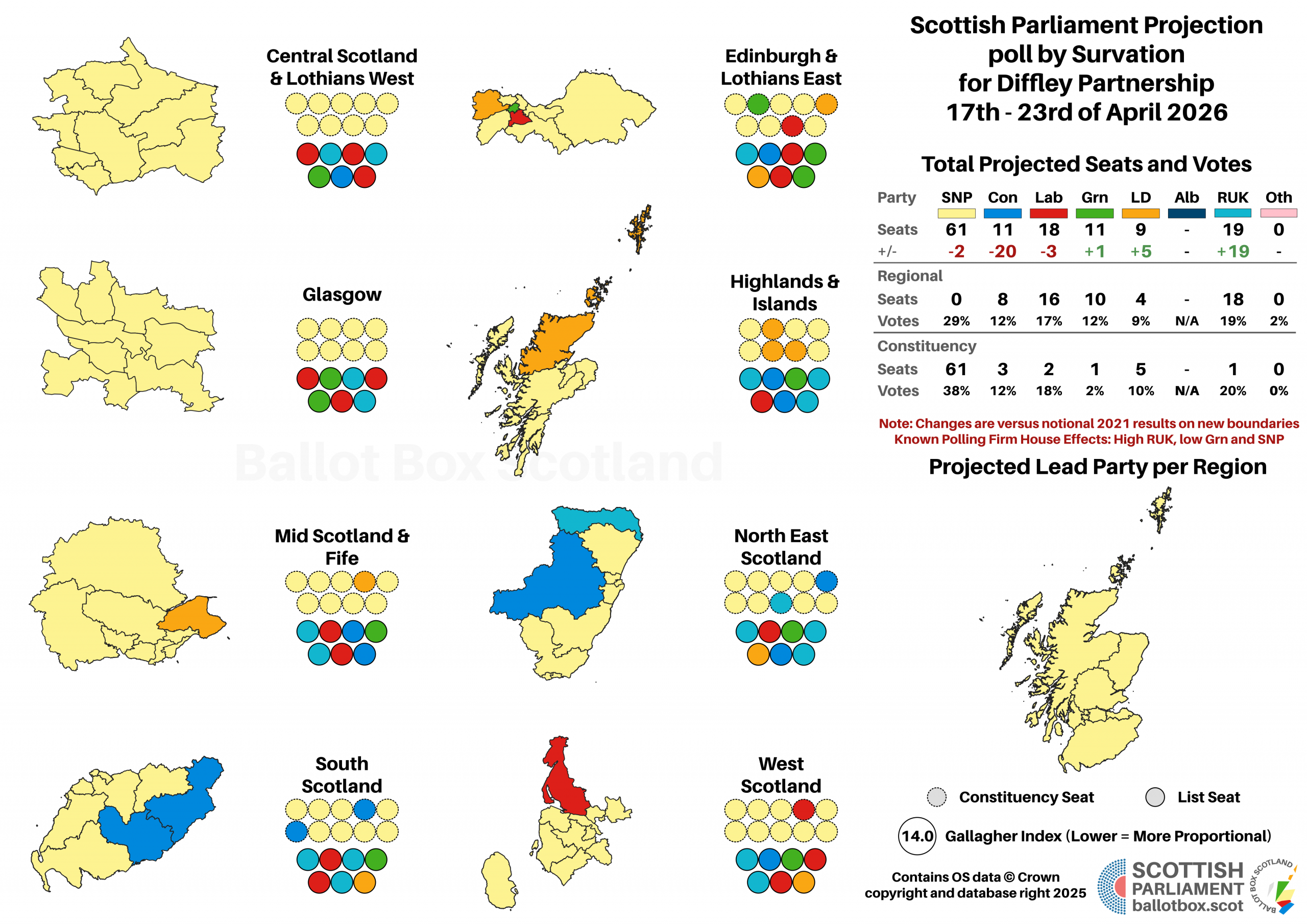
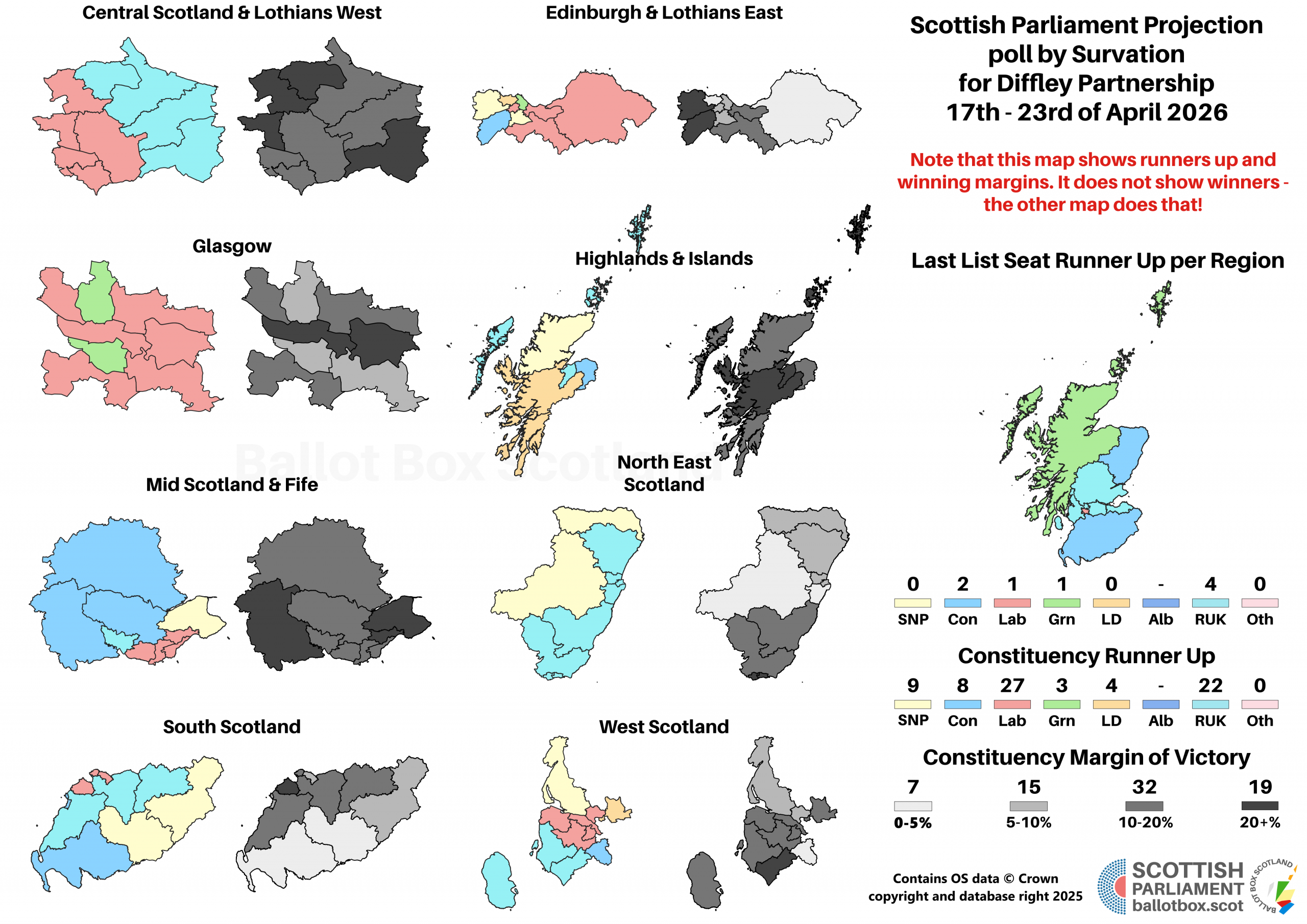
The improvement in the SNP’s constituency position helps swing back a handful of the constituencies they had been expected to miss in the earlier projection. Most notably that includes Aberdeen Deeside and North Kincardine, which had been an odd “my model struggles at the upper end of Reform support” outcome I didn’t really buy. That means a more comfortable Pro-Independence majority of 72 seats to 57 in this projection, but it still leaves the SNP themselves short.
Possible Majorities
Note: these majorities relate simply to passing a vote in the Scottish Parliament. They do not imply the formation of a full coalition government.
- Traffic Light: Labour, Lib Dem and Green
- Grand Coalition: SNP and Labour
- Union Bloc: Labour, Conservative, Lib Dem and Reform UK
Change vs Last Poll
Change vs 2014
Margin of error warning!
Again, the changes here are statistically meaningless, amounting to an additional slight edge for Independence but still in an effective tie. We’ll see if that changes at all in either direction over the next term of parliament, but for now, we’re still stuck.
Hypotheticals
As ever, the last little bit of analysis concerns those hypothetical and more proportional voting systems that BBS likes to play about with. The use of pure FPTP at Westminster is an affront to democracy, and though Holyrood fares far better, AMS is still deeply imperfect. The examples here simply transpose the poll findings onto more proportional voting systems – the reality is that different systems would of course result in different voter behaviour.
Scandinavian Style Westminster
If you find this or other Ballot Box Scotland output useful and/or interesting, and you can afford to do so, please consider donating to support my work. I love doing this, but it’s a one-man project and takes a lot of time and effort. All donations, no matter how small, are greatly appreciated and extremely helpful. (About Donations)