As the 2026 Scottish Parliament election approaches, keep up to date with all the latest polling and analysis on Ballot Box Scotland’s Holyrood Hub page!
Poll Details and Context
There’s less than a week to go until the big day, and polling is… well, there is some polling, certainly. Too much of it is nonsense MRP polling from dubious sources, alas, but here we have a proper poll from a normal firm. This is the last (for this election) in the regular partnership between the Sunday Times (link to original writeup) and Norstat (link to tables).
The previous Norstat covered the 30th of March – 1st of April 2026. Changes are shown as (vs that poll / vs last election).
Note: You may also notice some changes in the BBS website layout with a new theme. Hopefully all recent and relevant pieces have migrated over to the new theme alright, but if you spot anything odd, please drop me either an email or a message on Bluesky to let me know, including whether you encountered the issue on the desktop or mobile version of the website.
Regional Vote
Change vs Last Poll
Change vs 2021
Margin of error warning!
Half of the parties have no movement in this poll, and the other half… interesting movement. Pushing up just through the margin of error, the +4% for the Conservatives is the best poll for them in a year, though only by 1% over other recent highs. That’s a lot for them to gain since the last poll and isn’t really reflected elsewhere, so it may simply be that the last poll was at the lower end of the margin. Opposing two-point moves for the SNP (down) and Reform (up) are the only other changes here.
For the unchanged parties, there’s still stuff worth remarking on, even with the usual margin of error caveats well in mind. These are good figures for both the Greens and Lib Dems, and indeed for the Greens the fact their lowest pollsters are aligning on around 12% should give them some confidence they’ll hit that mark. The last Panelbase (as Norstat was then) in 2021 had the Greens on 8%, lower than everyone else, but spot on. Do not assume history will repeat so precisely, but be aware of it.
Constituency Vote
Change vs Last Poll
Change vs 2021
Margin of error warning!
There’s a lot more movement on the constituency vote but none of it, barring the big Green drop that reflects their confirmed limited slate of constituency candidates. The biggest increase is again for the Conservatives, which is actually kind of funny. Desperate to minimise losses, they have been falsely claiming that a Conservative list vote is what will stop an SNP majority and has in the past.
This is complete nonsense – if you redistribute the entire Conservative list vote in 2016 and 2021 to Labour and the Lib Dems, the SNP still don’t get a majority, because it was the SNP’s votes that were insufficient for that. What could stop an SNP majority is the Conservatives holding more than just Ettrick, Roxburgh and Berwickshire, which needs a solid constituency vote share in their other seats. This poll just so happens to give them that.
Similar to the Survation poll I commissioned, stripping out 7% of the vote from the Greens feels like it should give the SNP more of a boost than just 2%. We’re now at the stage where it’s less a case of seeing what other pollsters say and instead what we see on the day. If the Greens do indeed get 12% of the list vote, then 8% on the constituency would be about right based on relative performance in 2021. If the SNP don’t get a net benefit from that of about 4-5%, that would raise some very interesting questions about the Green voter base.
Seat Projection
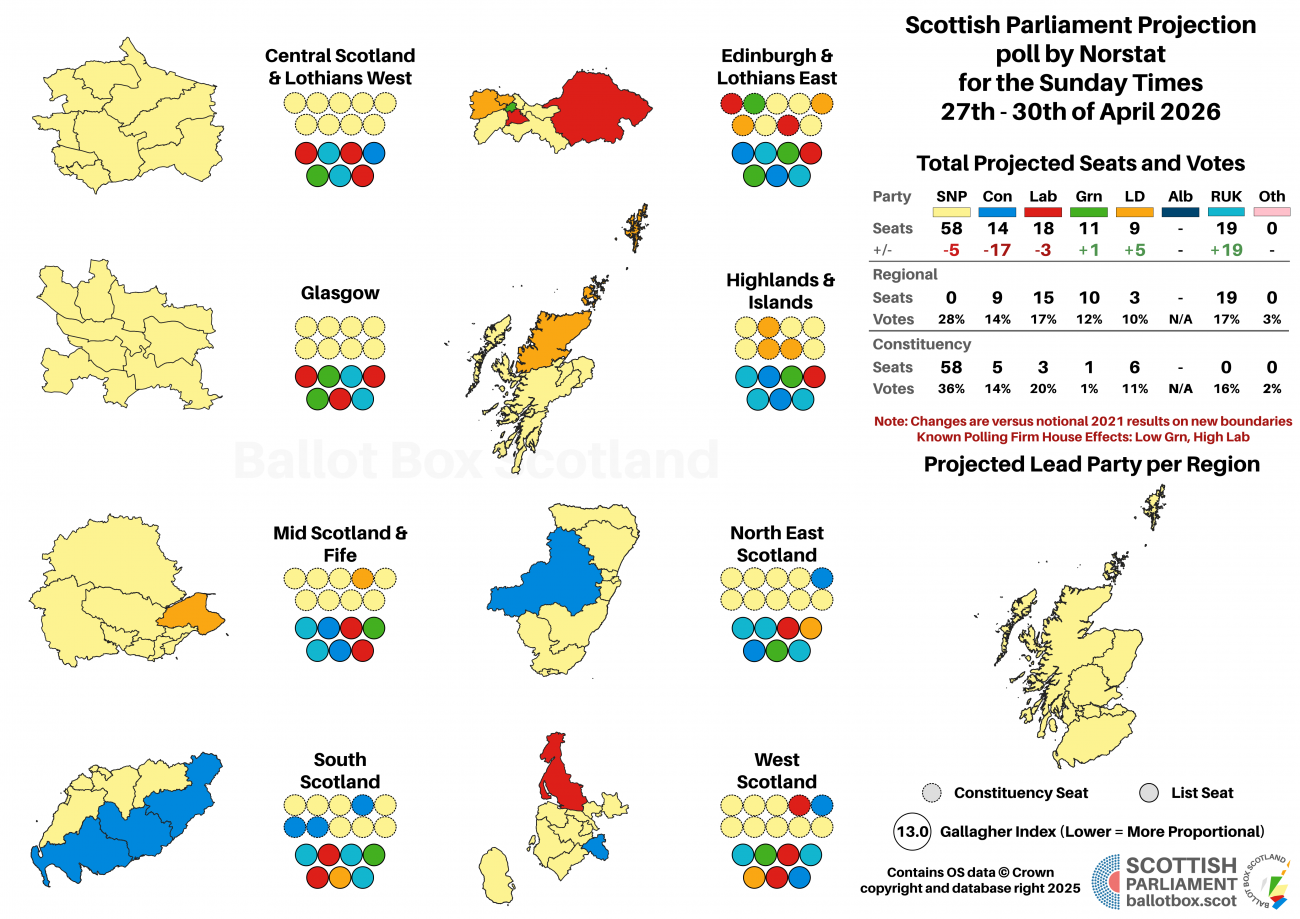
Projecting that into seats might give us something like this:
Please see this page for how projections work and important caveats.


Improvements for all of the SNP’s opponents in the constituency vote, however marginal, bear fruit in this projection by swiping a handful of constituencies from them. It still leaves a Pro-Independence majority of 69 seats when including the Greens, but it’s the second-lowest seat projection amongst recent polls. A notable feature of this is that it has Edinburgh Northern going Lib Dem. That’s something I can’t often convince my model of, as it can’t truly account for strong local campaigns, but it squeaks across here.
Here’s another fun little AMS quirk: if Labour didn’t regain East Lothian Coast and Lammermuirs but this model was otherwise identical, they’d tie in seats with Reform. It’s their relieving of proportional pressure in Edinburgh and Lothians East that in this scenario allows Reform a second MSP in that region. If we do see the SNP losing constituencies on Thursday, this is a really important dynamic to bear in mind: “X party gain from SNP” in the constituency does not, necessarily, mean “X party gain from SNP” overall, as it may be Y or Z party that benefit on the list side of things.
Possible Majorities
Note: these majorities relate simply to passing a vote in the Scottish Parliament. They do not imply the formation of a full coalition government.
- Traffic Light: Labour, Lib Dem and Green
- Grand Coalition: SNP and Labour
- Union Bloc: Labour, Conservative, Lib Dem and Reform UK
Change vs Last Poll
Change vs 2024
Margin of error warning!
Text
Change vs Last Poll
Change vs 2014
Margin of error warning!
I’ve still got the margin of error warning there but actually the big item here is at or just beyond it: +4% for Independence. I have to say this is classical Scottish polling patter: net decrease for the Pro-Independence parties in parliamentary VI, but support for Independence up. Most of this will be noise and statistical error but it’s amusing nonetheless. That makes this the best poll for the Pro-Independence camp since December 2022! Norstat have recently tended towards being a strong-Yes pollster, so I’d argue this is largely a continuing house effect rather than reflective of any real movement, especially given other polls remain pretty stuck.
Hypotheticals
As ever, the last little bit of analysis concerns those hypothetical and more proportional voting systems that BBS likes to play about with. The use of pure FPTP at Westminster is an affront to democracy, and though Holyrood fares far better, AMS is still deeply imperfect. The examples here simply transpose the poll findings onto more proportional voting systems – the reality is that different systems would of course result in different voter behaviour.
Scandinavian Style Westminster
If you find this or other Ballot Box Scotland output useful and/or interesting, and you can afford to do so, please consider donating to support my work. I love doing this, but it’s a one-man project and takes a lot of time and effort. All donations, no matter how small, are greatly appreciated and extremely helpful. (About Donations)