Posted in

By-Election Result: East Sutherland and Edderton

Background

After nearly five months without one, this week finally saw the return of council by-elections in Scotland. Like buses (and last week’s Westminster contests), two came along at the same time. In Highland, East Sutherland and Edderton went to the polls following the resignation of Independent Jim McGillivray. He’d been a councillor since 2007 but ill health meant he felt he couldn’t quite complete the full two decades.

Highland contests are always slightly harder to predict than in other areas because of a longstanding Independent streak. I noted as much in my preview, whilst also pointing out the strength of the Lib Dems locally. I therefore had this as a total tossup between the one Independent candidate and the Lib Dems.

Headline Results

Councillors and Key Stats

1 Councillor Elected:
⚪Independent: John Murray
Change vs 2022 (notional): Independent Gain from Lib Dem
Change vs vacating: Different Independent
Turnout: 39.7% (-10.7)
Electorate: 6587
Valid: 2597 (99.3%)
Spoiled: 18 (0.7%)
Quota: 1299
2 Continuing Councillors:
đźź Lib Dem: Richard Gale
🟡SNP: Leslie-Anne Niven

Candidates

➡️Reform UK: Jay Avrey
đźź Lib Dem: Eric de Venny
🟡SNP: Rebecca Machin
⚪Independent: John Murray
🔵Conservative: Eva Short

First Preferences

Swing vs 2022

Note: the retiring Independent won 19.0% and the Libertarians 1.6% in 2022.

First Preference History

That proved to be a sensible call, with Independent John Murray taking a respectable but not huge lead over the second placed Lib Dems. Given that Independents do tend to be relatively popular candidates for everyone else to send their votes, it’s no surprise that he then went on to win overall. The small Lib Dem decrease might seem surprising given their successes in the area since 2022, but seeing the doubling of the share that went to an Independent, that’s actually a very good performance for them.

That’s not how anyone else’s results could be described. The SNP lost a fair chunk of their share, though not to fatal levels; effectively, they returned to their pre-2022 baseline. Reform failed to make much of an impact, though bear in mind that the kind of dissatisfied voters that they excel amongst are also the kind of people who conceptually love the idea of an Independent. Lastly, the Conservatives saw an undeniably rotten result, losing around seven-eighths of their support and crashing below their 2012 lowpoint.

Transfers

Two-Candidate Preferred

Two-Party Preferred

TPP swing vs 2022

Although Murray was far enough off quota that it was mathematically possible the Lib Dems could overtake him, it would have been a tall order. In all my time covering STV elections, rarely indeed has the combination of “decent lead” and “vote share above 40%” failed to deliver victory. Transfers did narrow it ever so slightly for the Lib Dems, shaving 1% off Murray’s advantage at the final competitive stage, but otherwise it was an easy victory.

It’s a familiar tale if we re-calculate this as a party matchup between the Lib Dems and SNP. The SNP actually close the gap a little but not because they do better, simply because with so many more votes for an Independent, there’s more opportunity for incomplete ballots to exhaust entirely. Even with that somewhat artificial boost, they’ve only got half the support the Lib Dems do.

Detailed Results

Results by Polling District

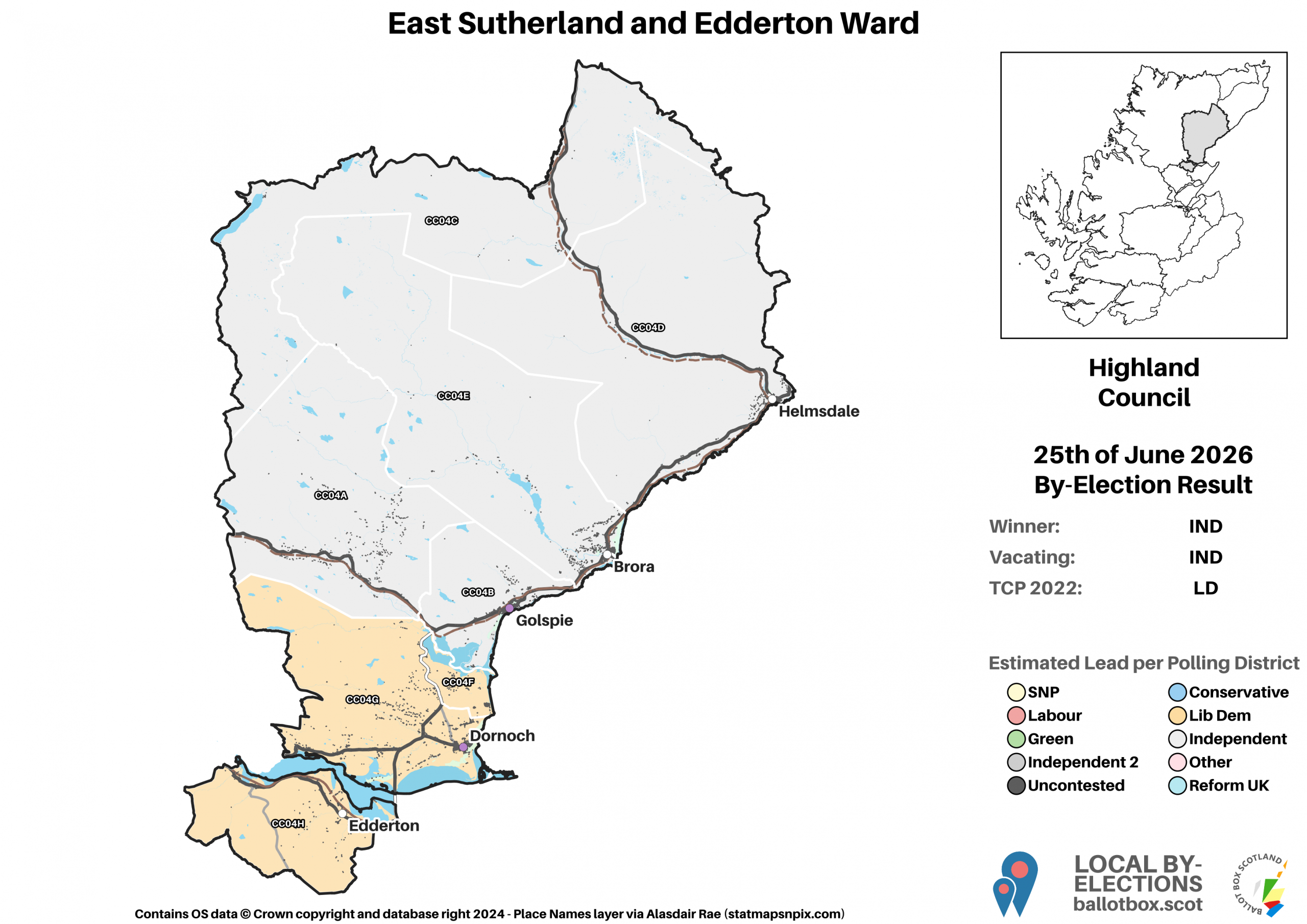
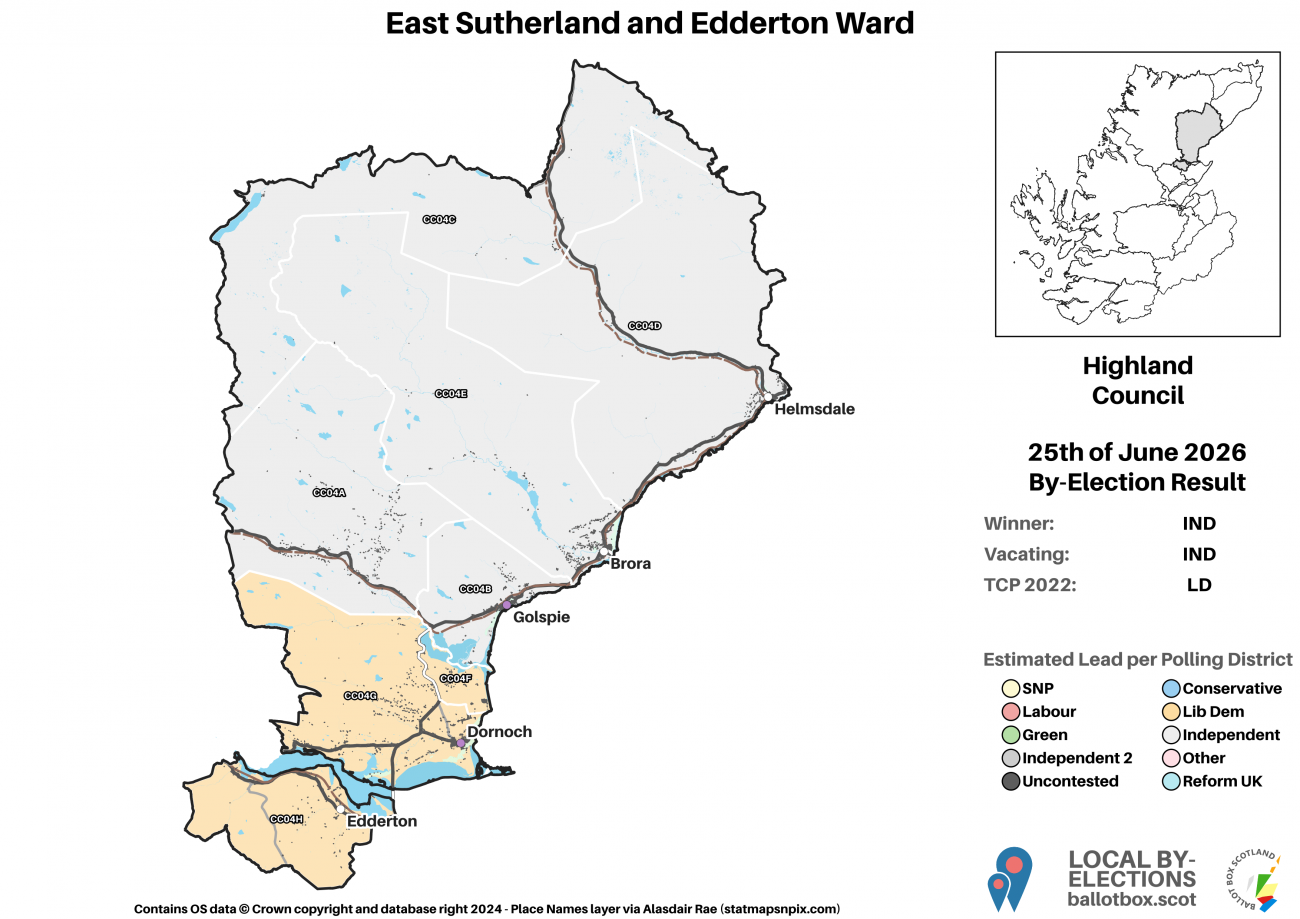
Turning now to how each candidate’s votes were distributed, and Highland’s exemplary new approach to box merging continues to give some lovely tidy data. From this we can tell that Golspie was very much Murray’s heartland, winning more than two-thirds of votes cast there. He led in the districts covering Brora and Helmsdale too; these were also the best patch for the three lower placed parties. The Lib Dems meanwhile dominated in the cluster of boxes covering Dornoch and Edderton, where they won a majority of the vote.

Second Preferences

Direct second preferences are broadly what you might expect in the scenario where there’s a popular Independent and no Labour or Green candidates. Both Murray and the Lib Dems were pretty popular in general, and were the most common pick amongst one another’s voters. For SNP and Conservative voters, the Lib Dems were the next most preferred option, whereas Reform voters had a tie between Murray and the Conservatives. Had one Reform second preference for each of those went Lib Dem, it’d have been a three way tie!

Our early summer run of by-elections continues next week, with Aberdeenshire’s Peterhead South and Cruden. That could be a particularly messy contest, with all of the SNP, Reform and perhaps even Conservatives in the running.

If you find this or other Ballot Box Scotland output useful and/or interesting, and you can afford to do so, please consider donating to support my work. I love doing this, but it’s a one-man project and takes a lot of time and effort. All donations, no matter how small, are greatly appreciated and extremely helpful.
(About Donations)