Background
A double bill of Highland by-elections presented two very different tales. Here in Caol and Mallaig, voters hadn’t actually had the opportunity to vote for their councillors since 2018, as in 2022 there were only as many candidates as there were seats. That meant that the Greens’ Andrew Baldrey unexpectedly found himself with a seat; it’s vanishingly unlikely they’d have won it at a contested election. His resignation for health reasons this year therefore gave locals the opportunity to actually choose one of their councillors for the first time in nearly a decade.
In my preview, I’d wondered if given the strength of the Lib Dems in the neighbouring ward that this might be a real opportunity for them. You can never write off Independents in the Highlands though and I belatedly clocked that one of those, Allan Henderson, had been a previous councillor. Of course, people’s lives change, but I can’t help but note that had Henderson just re-contested the ward in 2022 he’d have won then, allowed locals an actual vote, and avoided this by-election. Regardless, I therefore pegged this as a Lib Dem-Independent tossup.
Headline Results
Councillors and Key Stats
1 Councillor Elected:
⚪Independent: Sammy Cameron
Change vs 2022 (notional): N/A; uncontested
Change vs vacating: Independent Gain from Green
Turnout: 33.0%
Electorate: 7290
Valid: 2390 (99.3%)
Spoiled: 18 (0.7%)
Quota: 1196
2 Continuing Councillors:
🟠Lib Dem: John Grafton
🔵Conservative: Liz Saggers
Candidates
⚪Independent: Sammy Cameron
🟠Lib Dem: Isla Campbell
🟣Reform UK: Ryan Forbes
⚪Independent: Allan Henderson
🔵Conservative: Donald MacKenzie
🔴Labour: Michael Perera
⚪Independent: Matthew Prosser
🟡SNP: Aaron Taylor
First Preferences
First Preference History
Ultimately it was indeed one of the Independents that prevailed, but Henderson was defeated in his attempt to return by new candidate Sammy Cameron. As befits a ward that actually went its first two elections without party councillors, the pair of them had two-thirds of the first preference vote sewn up between them. Although Henderson didn’t win, his share was the second best out of his four runs, and it wasn’t a foregone conclusion based on first preferences.
Though far out of contention, the Lib Dems nonetheless were the strongest of a generally weak slate of party candidates. That applies to attracting transfers too, as if we eliminate the Independents, the Lib Dems get the majority of votes that aren’t exhausted (up to 36.2% of the overall vote, or 52.3% if accounting for exhausted ballots).
As poor as the SNP’s share was – the worst it’s yet been – they also do well in transfers, themselves taking a majority of what remains. That means that a very modest Reform share remains that way regardless of the presence of Independents; they go from 3.8% behind the SNP to 12.1% (20.3% vs 8.2%) in raw numbers, and 19% (30.1% vs 11.1%) if we assume exhausted Independent ballots would otherwise flow the same as the rest.
The remaining Independent, Matthew Prosser, was practically invisible compared to the top two, but he can at least be glad he beat the two other parties on the ballot. Neither Labour nor the Conservatives have ever been strong here, but this is a really grim result for both even so. If you want a marker of just how badly the Conservatives did here, there were precisely as many spoiled ballots (18) as there were votes for them.
Again, we can run transfers to see what happens without the Independents, and the Conservatives only go up to 1.7% in raw numbers, and still just 2.5% if notionally redistributing exhausted ballots. That compares to 2.7% and 4.5%, respectively, for Labour which is hardly brilliant either but is at least better and isn’t exactly fatal for them in the Highlands.
Transfers
Two-Candidate Preferred
Two-Party Preferred
With only 6% between the top two Independents, and the second placed of those being a former councillor, it wouldn’t have been impossible for transfers to flip the order and hand Henderson victory. In actuality, Cameron managed to slightly widen his advantage over transfer rounds, and was never under any threat of being defeated.
If we set it up as a purely party affair, the Lib Dems quite handily beat the SNP. We can do a similar exercise in redistributing the enormous pile of exhausted ballots as we did earlier (not something I usually do, it’s just because Independents were so dominant) and it’s more like 65% Lib Dem vs 35% SNP. Especially with Deputy First Minister Kate Forbes standing down in May, the SNP won’t enjoy figures like this cropping up in her constituency, which highlight the risk of it swinging to the Lib Dems.
Detailed Results
Results by Polling District
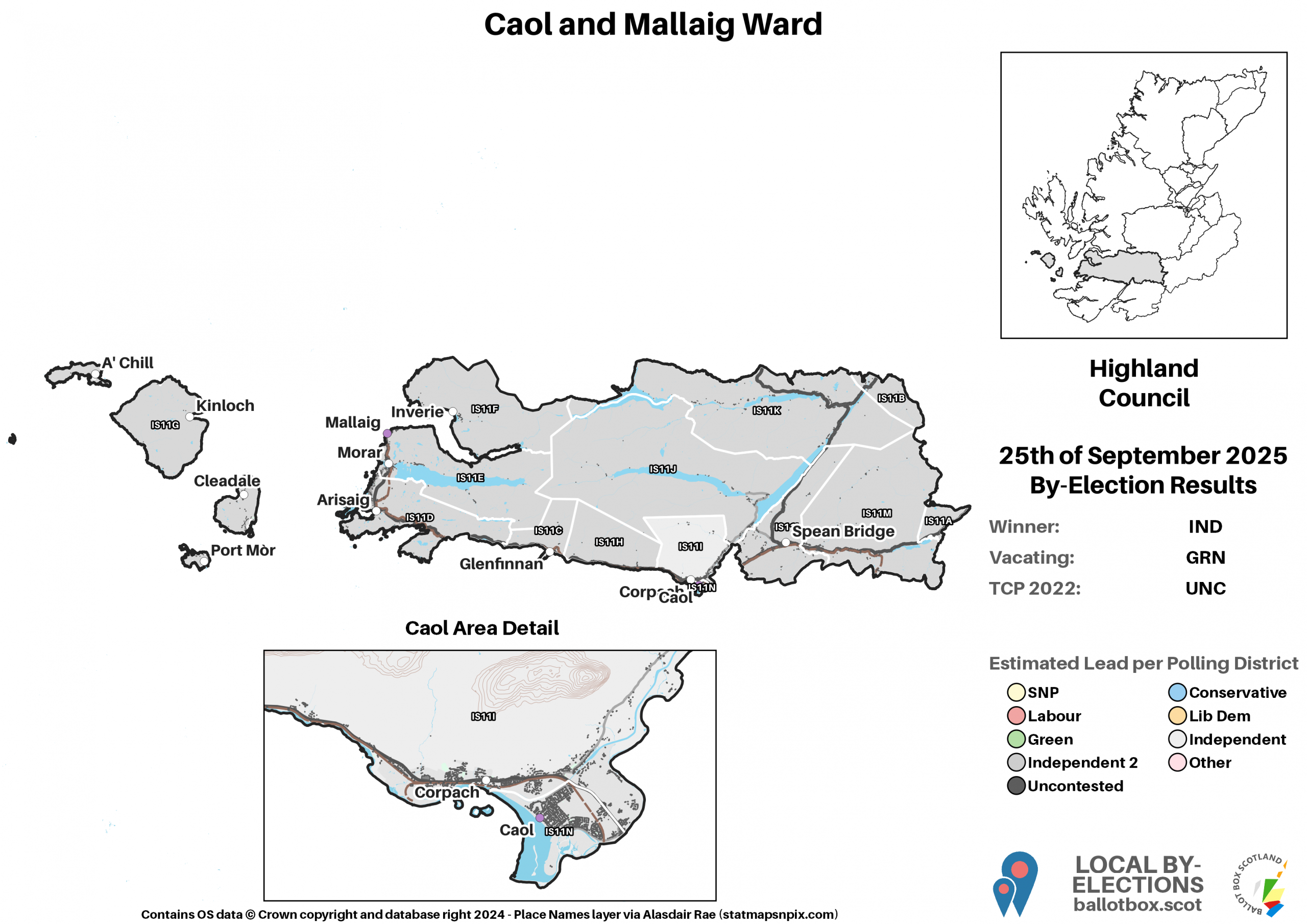
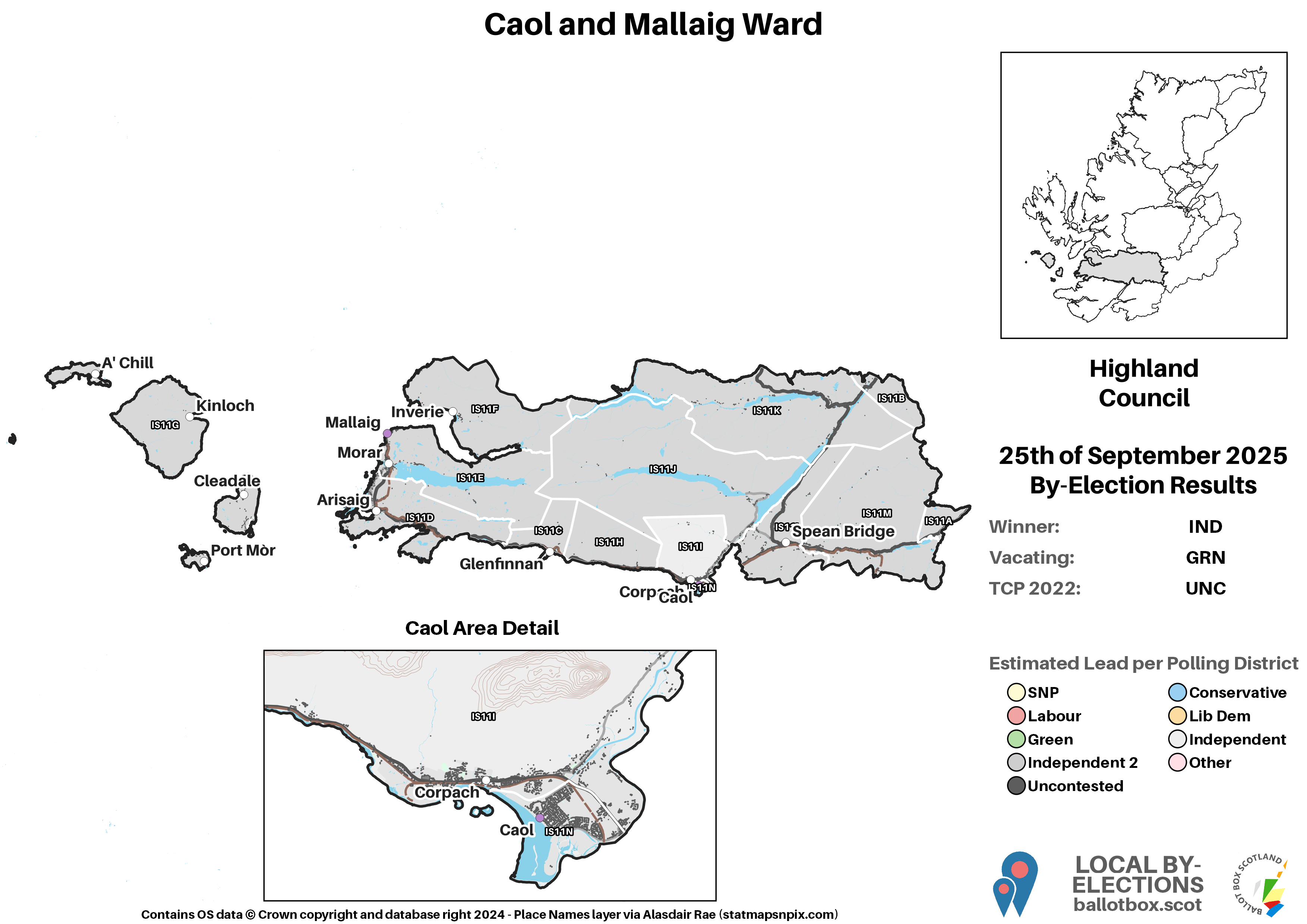
Highland Council continue to be absolute stars, not only getting their box mergers done extremely rapidly, but doing me a massive favour and adopting a new methodology for mergers that prioritises geographic proximity. That means that although there are still lots of mergers (that’s inevitable in the Highlands even at full elections given the small size of rural polling districts), they all involve neatly neighbouring districts. Lovely stuff!
This reveals a stark division in support for the top two Independents: Henderson actually takes an enormous lead in most of the ward, especially around Mallaig (and the Small Isles). The problem for him though is that the majority of the ward’s population is in Caol and Corpach, and there it was Cameron with eye-watering levels of support. His share of the vote in Caol was roughly the same as Henderson’s in Mallaig, but amounted to about 140 more physical ballot papers.
Of the other candidates, the Lib Dems and Reform UK were strongest in the districts around Spean Bridge; the SNP Arisaig and Glenfinnan; the other Independent Corpach; lastly, what few votes were cast for Labour and the Conservatives came in large part from Mallaig.
Second Preferences
Looking at direct second preferences, and it really shouldn’t surprise any of us to see that the top two Independents feature strongly in most transfer flows. Cameron and Henderson’s voters were most likely to second preference the other, whilst both the Lib Dem and SNP voter pools gave exactly equal numbers of second preferences to both of those Independents. Cameron was also the preferred Independent for both Reform and Prosser voters. The tiny rump of Labour and Conservative voters, resisting the Independent wave, were the only groups to favour a political party, that naturally being the Lib Dems.
We’ve got a couple of by-elections in October, though at time of publication nominations hadn’t closed for the second one. It’s therefore just Ayr North on the 16th to be linked to, where the SNP and Lib Dems will very much find their roles reversed compared to these Highland contests.
If you find this or other Ballot Box Scotland output useful and/or interesting, and you can afford to do so, please consider donating to support my work. I love doing this, but it’s a one-man project and takes a lot of time and effort. All donations, no matter how small, are greatly appreciated and extremely helpful.
(About Donations)