Background
The last Scottish by-elections of 2025 were an oddly coincidental case of re-runs in wards that already had one in November last year. In West Lothian’s case, Whitburn and Blackburn went back to the polls to replace the councillor they had elected then. For reasons known only to himself, Labour councillor David Russell quit both council and party after just months in the job.
In my preview I described this as “messy” and suggested there was lots to look out for. Given Labour had won by 5% over the SNP last year after transfers, even with them on a downswing I reckoned it was a tossup between the two. I said I thought Reform UK would cross 20%, but that “even anticipating a very strong Reform share, they’d have to place quite substantially first in order to win.”
I’d also said I expected to see the remaining Conservative vote crash even further, but wasn’t sure whether it might even take them below the Lib Dems and Greens. Lastly, I’d recommended keeping an eye on the votes for Independent Thomas Lynch who did well last time, not in the expectation he’d win, but to see if he’d be positioned for one of the four seats at the full election in 2027.
Headline Results
Councillors and Key Stats
1 Councillor Elected:
🟣Reform UK: David McLennan
Change vs 2022 (notional): Reform Gain from Labour
Change vs 2024 (notional): Reform Gain from Labour
Change vs vacating: Reform Gain from Labour
Turnout: 22.2% (+1.4 / -15.2)
Electorate: 16764
Valid: 3675 (98.8%)
Spoiled: 44 (1.2%)
Quota: 1838
3 Continuing Councillors: SNP: Jim Dickson
 Labour: George PaulSNP: Mary Robertson Dickson
Candidates
🟠Lib Dem: Douglas Butler
🟡SNP: Callum Cox
⚪Independent: Thomas Lynch
🔴Labour: Samuel McCulloch
🟣Reform UK: David McLennan
⚪Independent: Eddie Millar
🔵Conservative: Reece Sinnott
🟢Green: Robbie Walker
First Preferences
Swing vs 2024 By-Election
Swing vs 2022
First Preference History
I’ve had quite a good predictive record lately, but whilst there were still some solid predictions in there, in the end Labour weren’t anywhere near making this a tossup with the SNP. Instead, following hot on the heels of the Stranraer election where they first took a lead, Reform UK have topped the polls for the second time. They doubled their share of the vote compared to last year’s election, taking them a few points clear of the SNP. Although the the SNP themselves only dipped by just under an additional 1%, that represents their worst share in the ward, and the loss of just over a quarter of their vote since 2022.
To lose a mere quarter of one’s vote would however be a luxury for Labour. In an opposing trajectory to Reform, Labour lost nearly half of their vote compared to last year, over half relative to 2022, and nearly two-thirds compared to their peak in 2012. That’s a catastrophically poor showing, and far worse than I had anticipated. Perhaps before publishing the preview I should have paid more heed to the Buckhaven, Methil and Wemyss Villages result rather than assuming largely local circumstances?
Labour were followed relatively closely by Independent Thomas Lynch, who made modest gains on his previous result. I say modest, but given the transfer friendliness of an Independent versus Reform UK and the relative weakness of the SNP’s share, if this was a full election he’d have won a seat; the ward would have elected one each from Reform, the SNP and Labour before Lynch. That makes this a ward worth watching in 2027.
Keeping to the theme of doubling and/or halving, the Conservatives lost roughly half of their remaining vote, or less than a fifth of what they had in 2022. If this is what they are crashing to in wards where they were above 20% in 2017 during their revival, they are in extreme danger of being nearly wiped back out across the Central Belt. Although that kept them ahead of the largely unchanged Lib Dem and Green shares, it’s by such a small margin that once we account for turnout differentials between parties at by-elections, the Greens might be narrowly ahead in full election terms.
Lastly, the other Independent, Eddie Millar, can certainly at least say he stood for election.
Transfers
Two-Candidate Preferred
TCP swing vs 2024 By-Election
With only 4% between the top two candidates, transfers could have flipped the lead here. I’ve noted before that SNP and Labour voters are more likely to back the other party than Reform, and that’s why I thought Reform would need to “place quite substantially first in order to win.” As it turns out, preference flows are weak enough that they didn’t need to be all that substantially ahead, as once the transfer dust settled Reform emerged victorious, the first time they’ve elected a Councillor in Scotland, and only the third time a Farage outfit has elected anyone north of the border.
It was a close run thing though, as transfers did indeed favour the SNP, whittling the initial 149 vote and 4% lead down to 24 votes and 0.7%. In other words, even a small number of additional voters preferencing the SNP would have tipped it. Expect to see more situations like this given a combination of poor understanding of STV and an unwillingness to transfer to lesser evils as people get more scunnered with everyone.
Two-Candidate Preferred (SNP vs Labour)
SNP/Lab TCP swing vs 2024 By-Election
SNP/Lab TCP swing vs 2022
As a matter of interest I also re-calculated this as an SNP vs Labour matchup, and the unwillingness to transfer puts the SNP well ahead on this measure. This is a ward where Labour won in 2022 and last November, and presumably given transfers available would have won in TCP terms at every election up until now. I cannot emphasise enough how dire this result is for Labour, and why if they are still briefing journalists (as they were until quite recently) “well, we won in Barrhead and in Hamilton so it’s fine actually”, they are in for a nasty surprise.
Whilst it’s certainly true there’s a clear protest vote element to by-elections that wouldn’t exist at the full vote, Labour have fallen far too far for that to matter right now. Especially when you consider that the only voters less likely to turn out at a by-election than the SNP’s are the Greens’, I can’t imagine the “true” result in this ward taking Labour all that much more than 10% within range of the SNP’s share. It’s always hard to separate the spin from what parties really believe, but surely behind closed doors Scottish Labour have got to be panicking?
Detailed Results
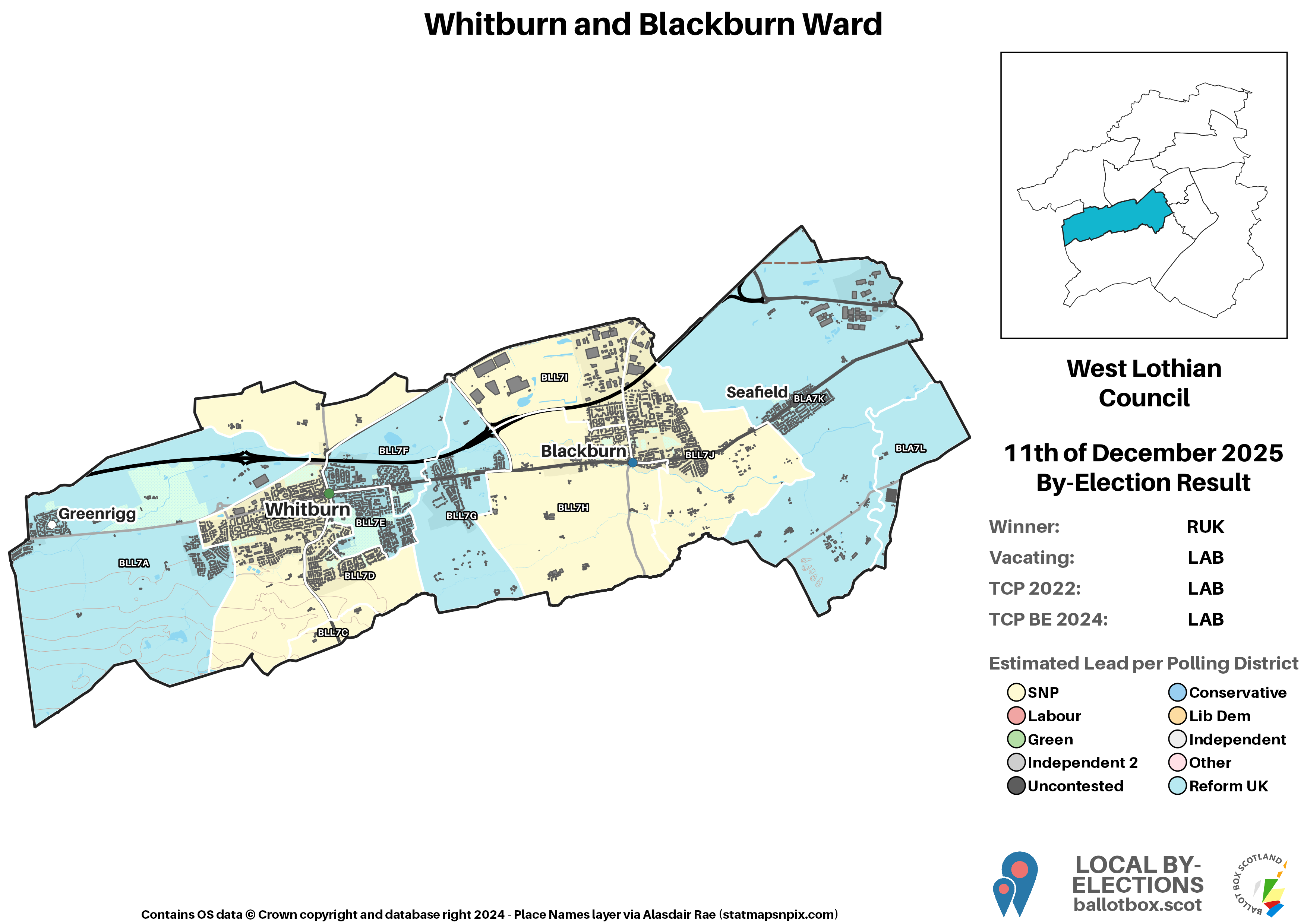
Results by Polling District
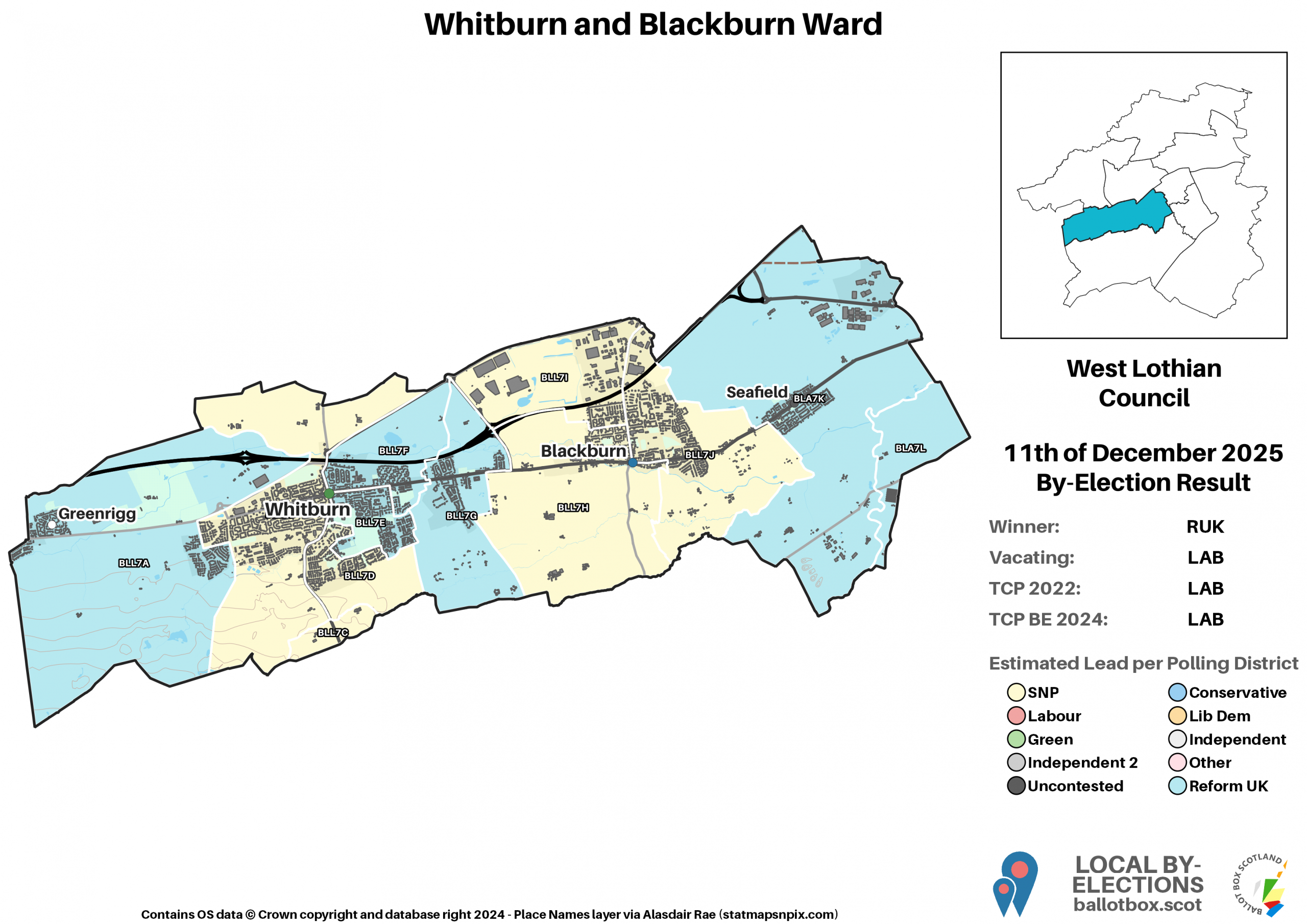
No surprises that with Reform out ahead, this is also the first time (since Stranraer was a hand count, there was no local data) that a map has ended up with teal-tinted polling districts. Reform took the lead in the districts covering Greenrigg and Seafield, as well as eastern Whitburn and, confusing as this may sound, East Whitburn which insists on being a distinct village. Of these patches, it was Seafield they did best in.
The SNP meanwhile came top in Blackburn and the majority of Whitburn, with Blackburn their strongest showing. For the other parties, Labour did best in southeastern Whitburn, the Lib Dems in western Whitburn, and both the Conservatives and Greens in East (not eastern) Whitburn.
Second Preferences
Turning to direct second preferences, think back to my point about relatively low use of preferences: over half of Reform voters only backed Reform, and nearly half of Labour voters likewise had no other preference. Even the Lib Dems and Greens, whose voters are typically highly likely to preference, still had roughly a fifth of their votes cast for them alone.
There were two sets of mutual flows here, between Reform and the Conservatives and between the SNP and Greens. In both cases, the flow from the larger party was notably weaker than the reverse. Especially for the SNP to Green flow you’d expect that of a ward of this type, though it is a few points higher than last year.
The remaining flows were unidirectional, and perhaps surprisingly so. Again in a ward like this it wouldn’t be uncommon to see Labour voters more likely to second preference the SNP over the Lib Dems, but this time around, it was the Lib Dems ahead. However, although Labour can usually depend on the reverse, this time the SNP was the most favoured destination for Lib Dem voters, as it was for Lynch. Of the few voters who plumped for Millar, a near majority unsurprisingly went for Lynch next.
That’s 2025 done and dusted in terms of Scottish elections, thankfully. We’ve got a couple coming up at the end of January but that’s so far ahead they don’t yet have previews. In between Christmas and New Year I’ll be publishing the usual BBS Annual Reviews, and that will truly be a wrap on the year.
If you find this or other Ballot Box Scotland output useful and/or interesting, and you can afford to do so, please consider donating to support my work. I love doing this, but it’s a one-man project and takes a lot of time and effort. All donations, no matter how small, are greatly appreciated and extremely helpful.
(About Donations)