Scottish polling continues to go through a fallow period despite the fact we’re just about to hit the one year marker for the next election. Barring some absolute junk polling from a firm I refuse to legitimise, we’ve basically been in a back-and-forth between Norstat and Survation for the past while. That’s finally been broken… with the publication of a second Survation in a row, rather than another major polling firm popping back up.
In absolutely classic Scottish politics style, there’s not been a huge amount in the BBS wheelhouse… and then it all hit on one day. First of all we got the final report on new Scottish Parliament Boundaries. Fortunately there were no differences from their final set of consultations, so I just had to press publish on my already-completed notional results calculations. Later on in the afternoon nominations closed for the Hamilton, Larkhall and Stonehouse by-election.
Then, of course, because why wouldn’t there be, there was a poll release. The Diffley Partnership (link to original writeup) are one of several folk (myself included) who default to Survation for polls, but with no April Norstat it meant we went straight from one Survation to another. Notably, this is the first “full” Survation poll since November: the ones since have been missing either or both of Westminster and Independence (link to tables).
The previous Survation covered the 6th – 13th of March 2025. Changes are shown as (vs that poll / vs last election). Note that Westminster compares to the 7th – 13th of January 2025, and Independence to the 1st – 15th of November 2024.
Regional Vote
As we’ll see by comparing both votes, a bit of a mixed poll this one. For the proportional side of things, the SNP are down a point whilst Labour are up two. That’s within margin of error but it narrows the gap between the two a fair bit in relative terms. Survation had a historic house effect in favour of Labour, and they are currently running notably above Norstat figures. In the absence of any other credible comparators it’s hard to get a sense of who might be more accurate right now though.
The biggest shifts here are between the parties of the right however. The Conservatives reclaim third place, with a weighty gain for them and an even chunkier loss for Reform UK putting them further ahead than they’ve been for a few months. The Reform figure last time was pretty remarkable, at 3% better than they’ve had in any other poll thus far, so I’m inclined to say that was a momentary outlier. The Greens also gain a couple of points, which brings them back into double-digits and at the upper end of their recent Survation polling.
Margin of error it may be but an Alba downtick once again pours cold water on nonsense FindOutNow polling that has them on a breakthrough. I know it drives some of them up the wall that I refuse to lend credence to their favourite pollster, but if it was even vaguely accurate, other pollsters would be seeing at least some improvement on 2021. That said, the person unhappiest with my commentary on this front is probably going to have to start being unhappy I’m not giving the Independence for Scotland Party their due or something…
Constituency Vote
This side of the poll is the opposite way round for the top two, with the SNP gaining at Labour’s expense. From Labour’s perspective, this is currently the wrong way around to get swings. In general the proportional vote matters more for the opposition parties than the constituency. At the moment though the SNP’s constituency success against anaemic list polling is absolutely wrecking proportionality. In this context, Labour want to be tipping as many constituencies as possible, because they just can’t make up the numbers proportionally otherwise.
We again see a big chunk taken out of Reform’s vote share, which further suggests the prior poll was an outlier. They remain narrowly ahead of the Conservatives, who along with the Lib Dems and Greens have a single point increase.
Seat Projection
Projecting that into seats might give us something like this:
Please see this page for how projections work and important caveats.
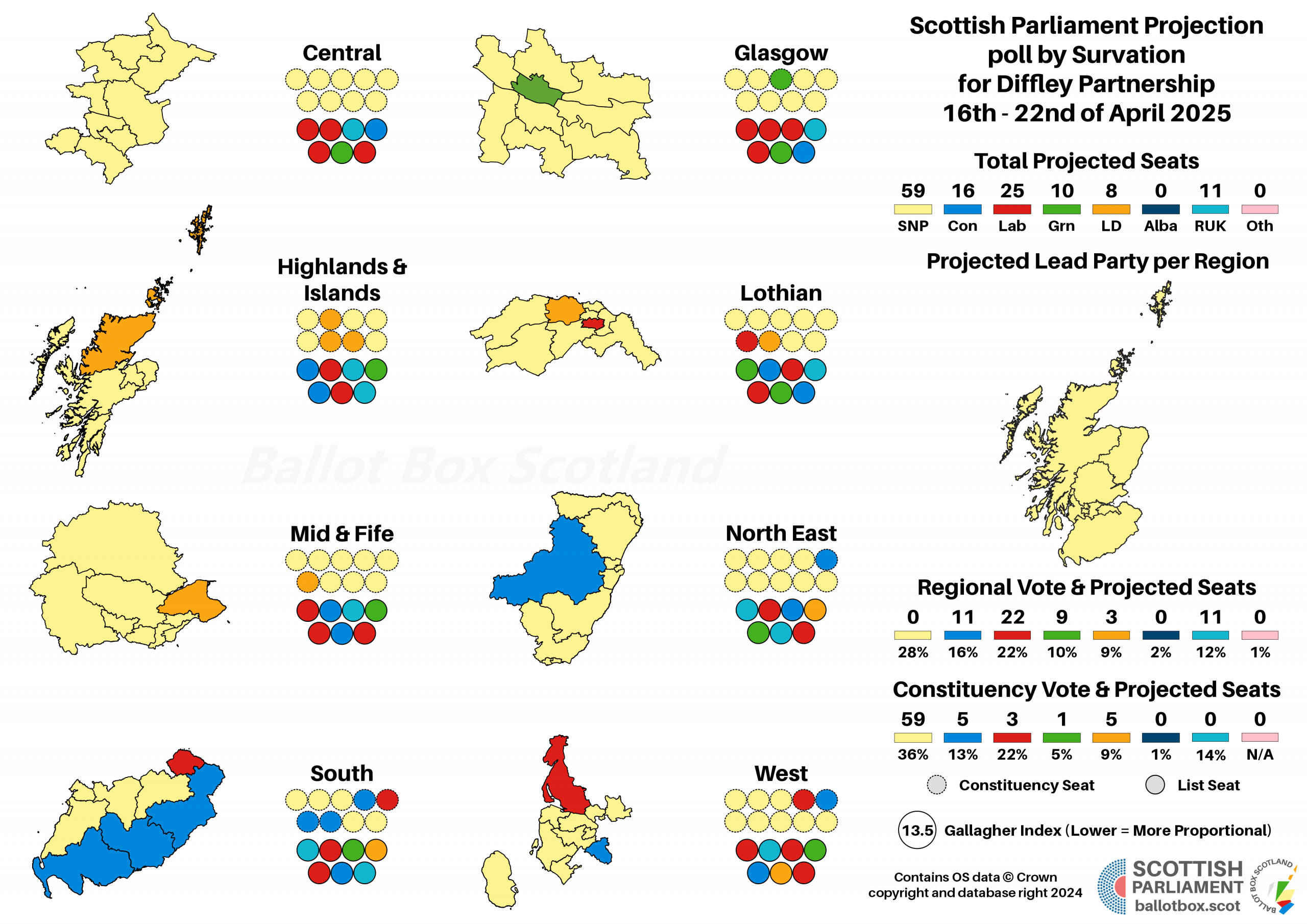
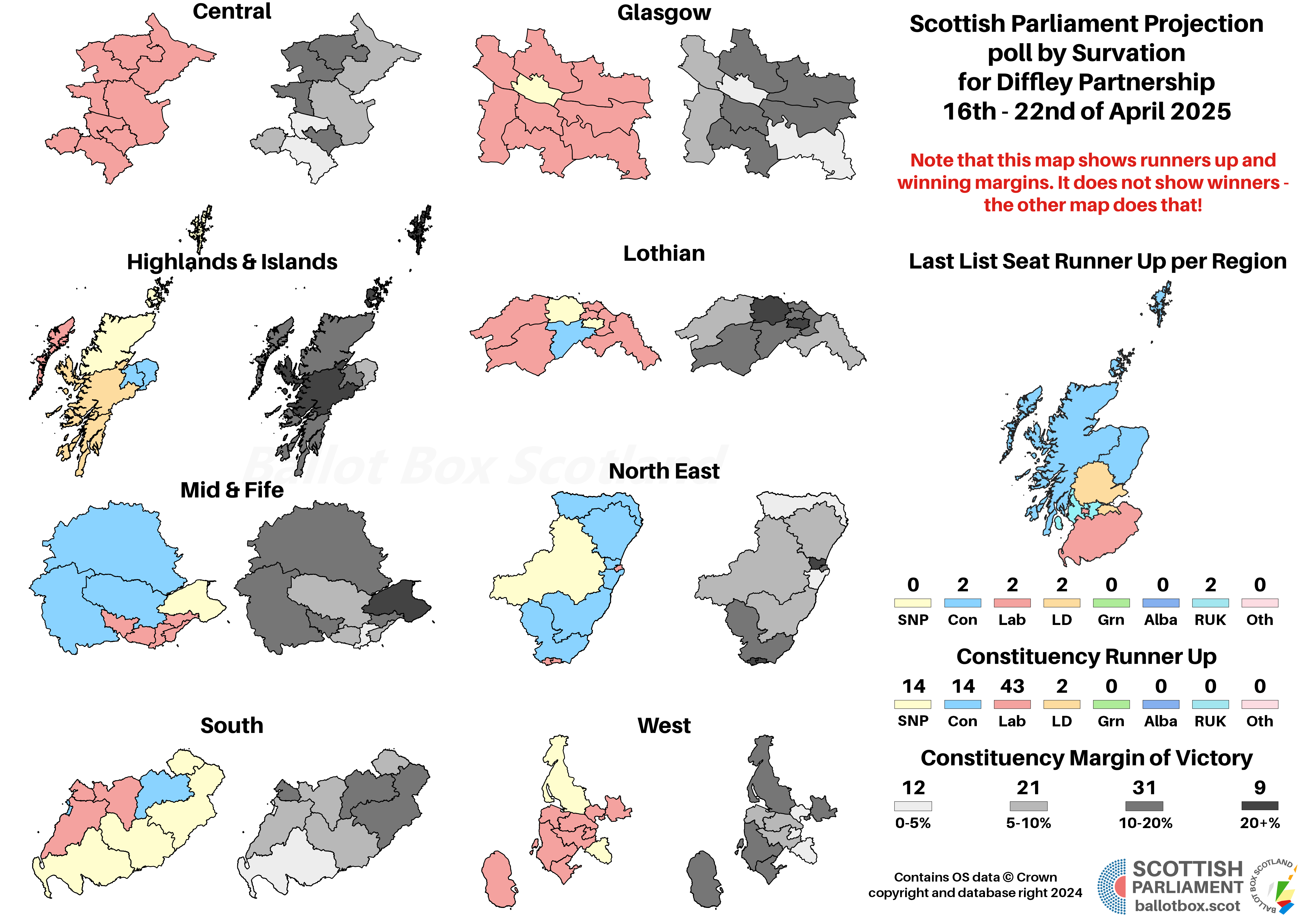
Everyone say goodbye to the map above! Due to the timing of the fieldwork, this gets to be the last ever projection I’ll do on the boundaries used in 2021. Whilst the Scottish Parliament can, in theory, reject the boundary change proposals, the fact that both the SNP and Labour have been running selections on the basis of the new ones suggests that is vanishingly unlikely to happen. The Greens in particular can bid farewell to the run of polling showing them winning Glasgow Kelvin, as that seat is about to disappear.
Emphasising my point about it really not mattering if Labour go up on the list vote if at the same time the SNP’s constituency lead widens, despite Reform dropping 8 seats versus the prior projection, Labour get none of them. They sit pretty on the same 25 seats they had then, whilst the SNP and Greens go from 2 short of a majority to 4 seats into one. Relations between the two may be weaker since the collapse of the Bute House Agreement, but it’s still pretty much guaranteed a Pro-Independence majority means an SNP First Minister.
To give you an idea of just how much the SNP are straining proportionality at the moment, scroll down to the “Various Other Systems” appendix towards the bottom. The “Pure List” line tells us how many seats each party should be getting if AMS was working flawlessly. It has the SNP on 40! That means FPTP is distorting our parliament in this case to a whopping 19 seats, or an almost 50% bonus for the SNP beyond what they are fairly due.
Just like Reform’s sweeping of the board in English counties the other day, if we saw this on the day it would be a phenomenal incidence of “you made your bed, now lie in it” for Labour having insisted on an FPTP-inclusive system in the first place. It’s all well and good putting in place proportionally sub-optimal voting systems because you think they’ll benefit you, until it suddenly isn’t.
Possible Majorities
Note: these majorities relate simply to passing a vote in the Scottish Parliament. They do not imply the formation of a full coalition government.
- Traffic Light: Labour, Lib Dem and Green
- Independence Bloc: SNP, Green and Alba
- Grand Coalition: SNP and Labour
- Union Bloc: Labour, Conservative, Lib Dem and Reform UK
In contrast to the Holyrood vote where there were plenty of swings, some of which actually hit the point of being statistically meaningful, basically nothing changes for Westminster. That may be due to the fact this is comparing with January rather than March, mind you. Regardless, the Conservatives and Greens are up a single point. That’s it.
Everyone else is static, which means Labour down almost a third of their vote since last year’s election and the SNP with a clear lead. Whilst their sheer strength in the Central Belt would help prevent a Labour wipeout, it’s still highly likely they’d lose half or more of their seats on these kinds of shares.
We’re going even further back for the constitutional comparator, and again it’s absolutely no change in statistical terms. You may note that there are two -1 figures but no corresponding gains elsewhere; that’s simply the sticky issue of rounding popping up. The last poll summed to 101% using rounded figures, this one to 99%. Quirks of arithmetic aside, same thing I always say at this point: if you think with polling still spitting out stuff like this we’ve somehow resolved the constitutional question, I’ve got a bridge to sell you.
Hypotheticals
As ever, the last little bit of analysis concerns those hypothetical and more proportional voting systems that BBS likes to play about with. The use of pure FPTP at Westminster is an affront to democracy, and though Holyrood fares far better, AMS is still deeply imperfect. The examples here simply transpose the poll findings onto more proportional voting systems – the reality is that different systems would of course result in different voter behaviour.
Scandinavian Style Westminster
If you find this or other Ballot Box Scotland output useful and/or interesting, and you can afford to do so, please consider donating to support my work. I love doing this, but it’s a one-man project and takes a lot of time and effort. All donations, no matter how small, are greatly appreciated and extremely helpful.
(About Donations)